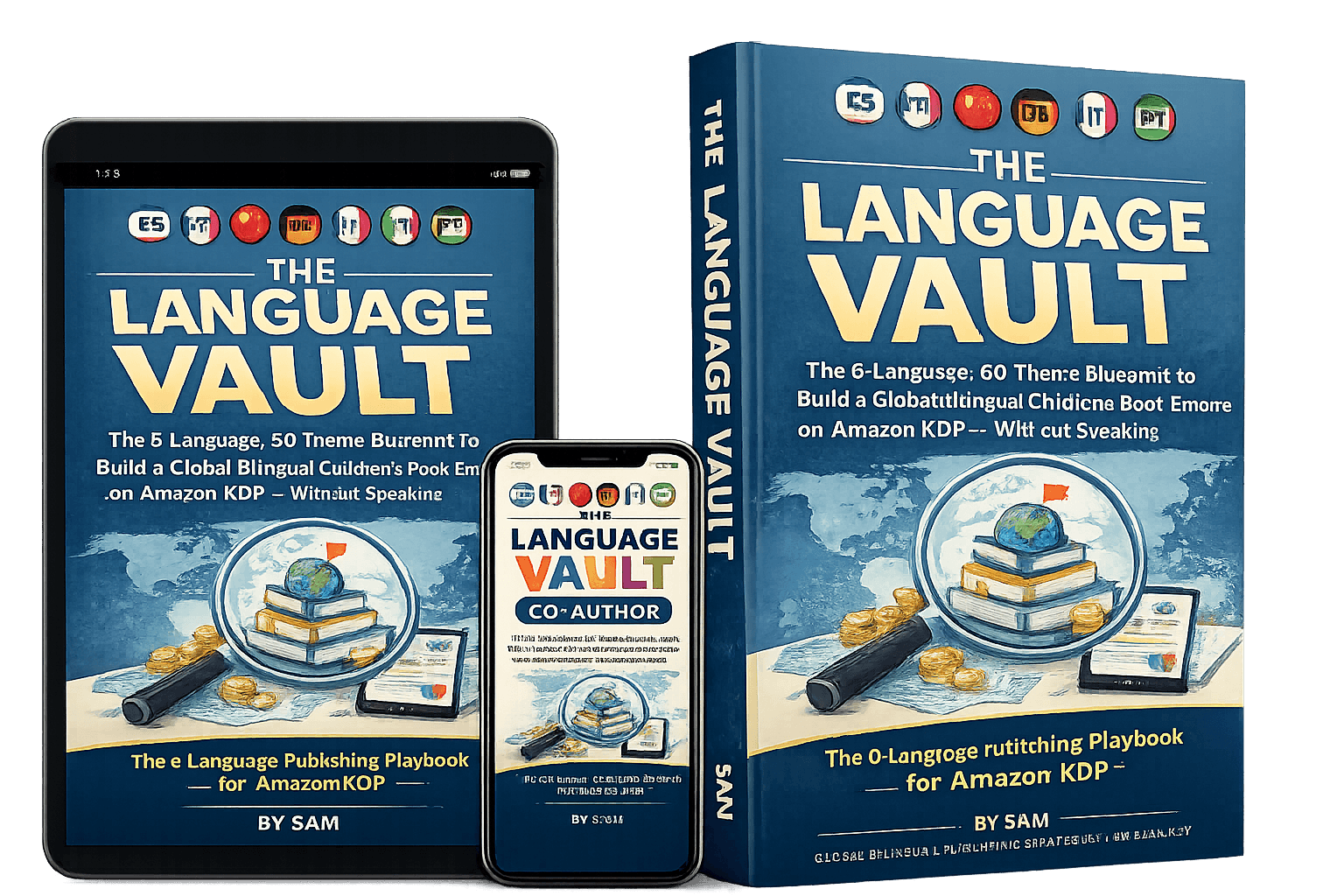
One story. Six languages. A catalog you actually built.
The Language Vault hands you the exact prompts, market notes, and workflow to take a single children's story into Spanish, French, Mandarin, German, Italian, and Portuguese — with a verification habit built in, so you can vouch for every page even in a language you don't speak.

You've proven the format works. Now what?
You only speak (or checked) one second language
Your English–Spanish book is out. But German, Mandarin, and Italian feel like a different universe — you have no way to tell if a translation actually reads naturally.
You're not sure if six editions of one story looks like spam
You've heard vague warnings about "duplicate content" on Amazon and don't want to risk your account without understanding where the actual line is.
Keyword research in a language you can't read feels impossible
You know Amazon.de and Amazon.fr exist. You have no idea what a German or French parent actually types into that search bar.
10 themes × 6 languages = 60 distinct book cores
60 is a planning ceiling, not a promise. The guide's own rollout plan spreads this across 12 months, starting with your two or three strongest themes — because a rushed, unverified catalog is worse than a small, well-reviewed one. How large your catalog eventually grows, and what it earns, depends entirely on your own effort, execution, and the market — see the Earnings Disclaimer below.
One English draft in. Six verified, culturally-checked editions out.
- 01
Write once, using the Master Story Arc
A reusable six-beat story shape that adapts to any of the 10 included themes — you're never starting from a blank page.
- 02
Run the Polyglot Master Prompt
Paste in your English story and get back all six language editions, each with vocabulary calibrated for ages 3–8, a phonetic guide, and a cultural-notes flag.
- 03
Do the 15-minute native-check
The guide shows you exactly how to get a fast, low-cost native-speaker read-through for each language before you publish — the step that protects your ratings.
- 04
Format and launch per storefront
Character-count adjustments, accent-safe fonts, and market-specific keyword research for each of the storefronts covered in the guide.
↳ Excerpt only. The complete, copy-paste Polyglot Master Prompt — with every language-specific instruction — is inside the guide.
Six deep-dive chapters, one per language
Each language section covers its regional variant choice, the specific pronunciation hurdle English-speaking parents hit most, and a market insight for where that language actually sells.
Neutral Latin American default
Covers the vosotros/ustedes fork, the rolled-R exercise for parents, and why Amazon.com.mx and US Hispanic households matter more than people assume.
European vs. Canadian French
The handful of vocabulary differences that matter for Amazon.ca, plus a nasal-vowel phonetic key parents can actually use.
Tones, Pinyin, and diaspora demand
Why every edition needs full Pinyin under the characters, the four-tone challenge explained simply, and a note on the mainland China storefront closure.
Compound words & short sentences
How to keep sentence structure simple even when individual words run long, plus the soft/hard "ch" sound explained for non-German-speaking parents.
Clear vowels, double consonants
Why Italian is one of the more approachable languages to read aloud, and the stop-and-hold rule for doubled consonants like "pizza."
Brazilian default, the nasal "ão"
Why Brazil's growing storefront is a comparatively low-competition opportunity, plus a simple phonetic approximation for the nasal sound.
A ready-made plot hook for every theme
Each theme includes a plot hook, five core vocabulary words, a cultural adaptation tip, and a ready-to-run Claude prompt.
This is for you if…
- You've already built (or are building) one bilingual children's book and want a repeatable system for more languages and themes.
- You're comfortable running a written AI prompt and following a structured, multi-step workflow.
- You're willing to budget a small amount of time and money for a native-speaker verification pass on every language edition — this guide treats that step as non-negotiable.
- You want market-specific guidance — pricing, keywords, storefronts — rather than a one-size-fits-all "just translate it" approach.
- You're thinking in terms of a catalog built over months, not a single overnight launch.
This probably isn't for you if…
- You haven't written or personalized a first bilingual story yet — this guide builds on that foundation rather than starting from zero (see Bilingual Buddy Co-Author).
- You're looking for a guaranteed income figure — publishing income depends entirely on your effort, execution, and market conditions, and no guide can promise it.
- You want to skip the native-speaker verification step — the guide is explicit that this is the difference between a catalog that holds its ratings and one that doesn't.
- You need certified, professional-grade translation for legal, medical, or official documents — this is built for children's stories, not certified translation work.
- You're hoping to publish all six languages, ten themes, in your first week — the included rollout plan is intentionally paced over months for a reason.
24 chapters, from first prompt to a running catalog
The Global Opportunity
Why six languages multiply your reach instead of multiplying your workload.
The Combinatorics Math
The honest 10×6 expansion matrix, and a realistic 12-month rollout plan.
The Polyglot Master Prompt
The complete copy-paste prompt plus the 15-minute native-check method.
Six Language Deep-Dives
Regional variants, phonetic focal points, and market insight per language.
The 10 Universal Theme Vaults
Plot hooks, vocabulary, and cultural adaptation tips for every theme.
Formatting Across Alphabets
Character-count math for Mandarin, accent-safe fonts, and page-count fixes.
Global Keyword Strategy
A cultural keyword-harvesting method for storefronts in languages you don't read.
Pricing & Royalties Across Borders
Starting price ranges for eight storefronts, and how to sanity-check them.
The Illustration Engine
Building a character bible that keeps art consistent across every edition.
Cover Design That Converts
What belongs on a bilingual cover, and how to test it at thumbnail size.
Your First 30 Days
A day-by-day sequence for your first six-language theme launch.
Reviews & Reputation
How to read and respond to reviews in languages you don't speak — the right way.
Rights & Licensing
Plain-language orientation on ownership, asset licensing, and trademark care.
The Global Ops Checklist
A print-and-run checklist for every launch, from first draft to first review.
FAQ, Team, Taxes & the Long Game
Delegation basics, an international-payout orientation, and three honest launch patterns to plan around.
One system. Six languages. Your pace.
One-time payment. No subscription.
- ✓ The full Language Vault guide (24 chapters)
- ✓ The complete, copy-paste Polyglot Master Prompt
- ✓ Six language deep-dive chapters (Spanish, French, Mandarin, German, Italian, Portuguese)
- ✓ 10 ready-to-run theme prompts with plot hooks and cultural adaptation tips
- ✓ Market-by-market pricing, keyword, and formatting guidance for 8 storefronts
- ✓ The Global Ops Checklist and a 30-day launch sequence
Before you go
Do I need to already own Bilingual Buddy Co-Author?
It's not required, but the Language Vault builds directly on that guide's Master Story Arc and Lingua Prompt approach. If you're starting from zero, we'd recommend the original guide first.
Do I need to speak any of these six languages?
No. That's the entire premise — the guide walks you through an AI-translation workflow plus a fast, low-cost native-speaker verification step for each language, so you never have to read or speak the target language yourself.
Will publishing in six languages guarantee more sales or income?
No. This guide teaches a publishing and translation workflow. It does not promise or guarantee sales, royalties, reviews, or income of any kind. Any figures, catalog sizes, or examples referenced are illustrative only — see the Earnings Disclaimer below.
Is publishing the same story in six languages against Amazon's rules?
The guide addresses this directly: genuinely distinct language editions serving different-language readers are treated differently from duplicate English listings. That said, marketplace policies are set by Amazon and can change — always confirm current content and publishing policies directly on KDP before publishing.
What format does this come in?
A downloadable PDF, delivered instantly after purchase. Nothing physical is shipped.