Turn the One ProductYou Already Have Into aWhole Catalog of Sellable Products
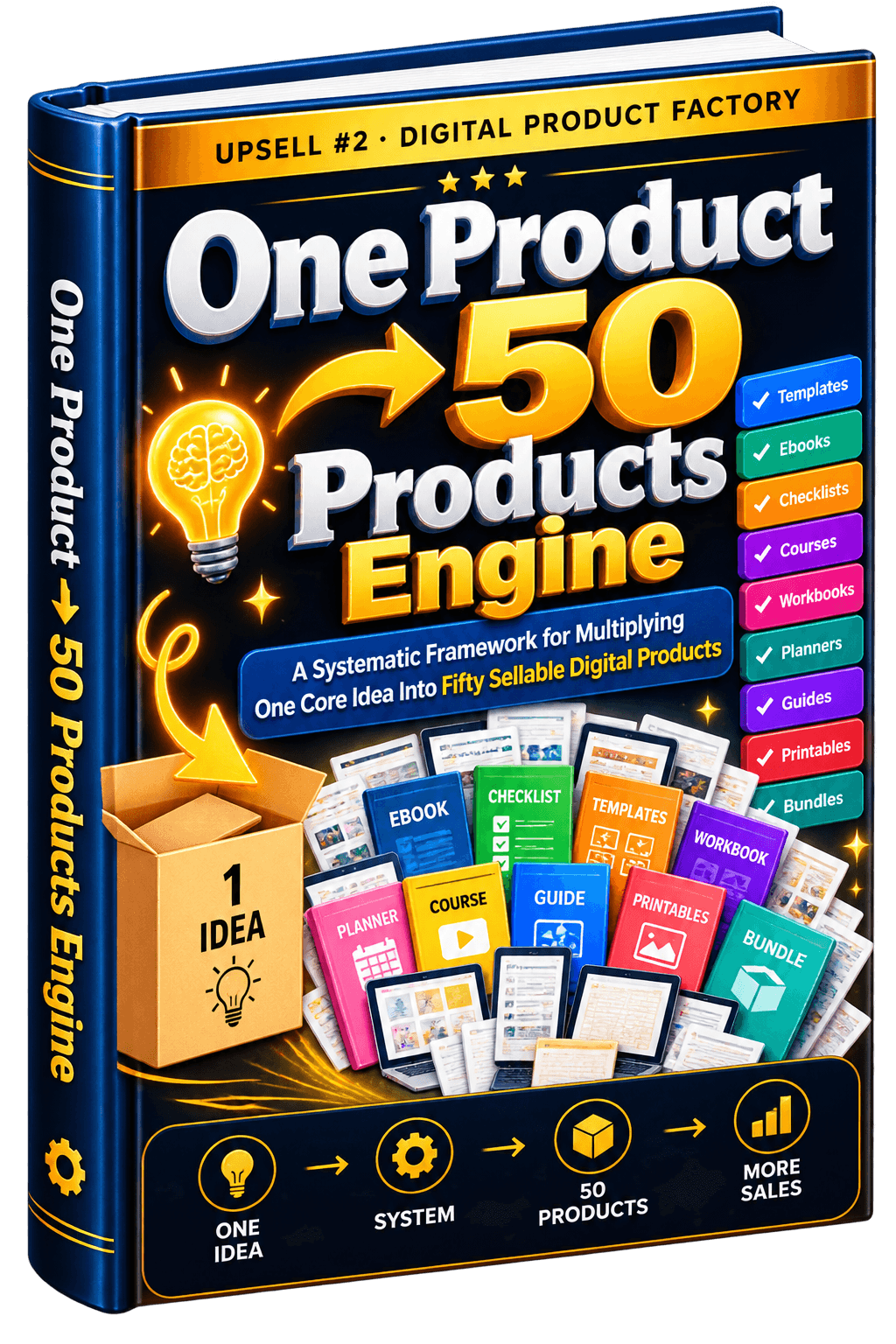
Most product catalogs stall for one quiet reason
Somewhere along the way, most creators absorb a rule nobody ever says out loud: every new product needs a brand-new idea.
So they hunt for fresh concepts. They run fresh research. They validate, outline, write, and design from zero, again and again. Eventually they either run out of concepts or run out of energy, long before they run out of ways to genuinely help their audience.
Here is the more generous truth this guide is built on: a single, deep body of knowledge usually holds far more sellable products than its creator has ever pulled out of it. Not because the ideas aren't there, but because the material has never been deliberately mined for everything it contains.
The Engine gives you the method for mining it.
A system for finding
the products already inside your product
This is a written framework, not a list of random ideas. You start with one core asset, map it into components, then run those components through four lenses. Each lens produces genuinely different, sellable angles: a new format, a new depth, a new audience, or a new situation.
The number fifty is there to break a limiting habit, the instinct that one idea is good for exactly one product. It is not a promise. Some creators will land on ten or fifteen strong ideas from their material, which is a perfectly good outcome. Others will find fifty is easily passed. Your count depends on the depth of your expertise and the work you put in.
Four ways to multiply one idea
Each framework gets its own chapter and its own worked example.
FORMAT
Ask which of six formats each component could live in: written guides and ebooks, templates and fillable documents, checklists and quick-reference sheets, video walkthroughs and mini-courses, audio lessons, or interactive tools such as calculators. This one exercise alone often multiplies a component map several times over.
DEPTH
Offer each component at three levels: a quick-start for buyers who want a fast result, a standard treatment, and a deep-dive that goes past what your core product covers. You'll also see how to price the tiers so they don't blur together.
AUDIENCE SLICE
Reframe a component for a specific sub-segment of buyers, such as a particular experience level or life stage, without falling into superficial slicing where only a few nouns change. Learn how to test a slice before you produce it.
USE CASE
Slice by situation instead of by person: the specific problem someone is solving right now, or the tool or platform they're working in. See how a use case differs from an audience slice, and how to combine the lenses.
A worked example runs through the guide. In it, a single component of a home-baking product supports as many as nine distinct product variations from the format and depth lenses alone, before audience and use-case angles are even applied.
Then build them quickly and sensibly
Ideas are only useful if you can turn them into finished products. Three chapters cover the mechanics.
WRITTEN DERIVATIVES
Extract standalone guides, checklists, quick-reference sheets, and swipe files from material you already have. Learn why a proper editing pass matters, so repurposed content reads as its own product and not a copied section.
TEMPLATES AND TOOLS
Turn decision frameworks and scoring systems into spreadsheet tools or simple no-code interactive tools. Cover testing, pricing, licensing, and updates so a tool holds up after you sell it.
VIDEO AND AUDIO
Know when video and audio are worth the extra effort, how to record a tightly focused walkthrough, how to pull derivatives from content you've already made, and how to keep production sustainable.
Bundle, prioritize, and
keep the system running
BUNDLE DERIVATIVES INTO NEW OFFERS
Group products by format, by depth tier, or by use case or audience. Name and position each bundle clearly, use seasonal rhythms where your niche has them, and avoid bundle overload.
PRIORITIZE WHAT TO BUILD FIRST
Score every idea on existing demand evidence and production effort, place it on a simple priority matrix, and start with what buyers have actually asked for. You'll also learn how to avoid analysis paralysis.
RUN IT AS AN ONGOING PRACTICE
Keep a living component map, document a repeatable workflow, set a sustainable cadence, know when to retire a product, and see how to measure the return on the whole practice.
What's inside the guide
12 chapters, 82 pages, written to be applied to one specific product as you read.
✦ WORKSHEETS AND CHECKLISTS BUILT INTO THE PAGES ✦
Repurposing, not repackaging
Buyers recognize repackaging quickly, and they resent it: the same content, at the same depth, in the same format, sold again under a new title.
This guide is built around the opposite idea. Every framework aims at a product that is genuinely distinct, something a buyer would see as worth its own price. So the system works for your audience as much as for your catalog, delivering knowledge in the form, depth, and context each buyer actually needs.
Is this the right guide for you?
A GOOD FIT IF
- You have a core product that has already shown real buyer interest and satisfaction
- You're tired of starting from zero every time you want to launch something new
- You're willing to do the work of mapping, choosing, building, and publishing
PROBABLY NOT FOR YOU IF
- You don't have a product or an area of expertise yet. Multiplying an unproven idea only gives you many unproven ideas
- You want done-for-you products or software. This is a framework you apply yourself
- You expect guaranteed income or results from reading a guide
Get the One Product → 50 Products Engine
One guide, twelve chapters, and a method you can apply to your own product today.
- ✔The complete 82-page One Product → 50 Products Engine guide (PDF)
- ✔Four multiplication frameworks: format, depth, audience, and use case
- ✔Build guides for written, template and tool, and video and audio products
- ✔Bundling, prioritizing, and ongoing-system chapters
- ✔Worksheets, checklists, and a scoring template built into the guide
Try it for 7 days. If it's not for you, get your money back.
Read the guide. Work through the mapping exercise in Chapter 2 with your own product. If you decide within 7 days of purchase that the guide isn't right for you, send a refund request using the support contact on your purchase receipt or through WarriorPlus support, and your purchase will be refunded.
The point is simple: you get to judge the frameworks on your own material before your money is committed.
Questions, answered plainly
Start with the product
you already own
Map it, run it through the four lenses, and choose your first derivative to build. Get the guide today at $36.99, and use the 7-day guarantee to test it on your own material.