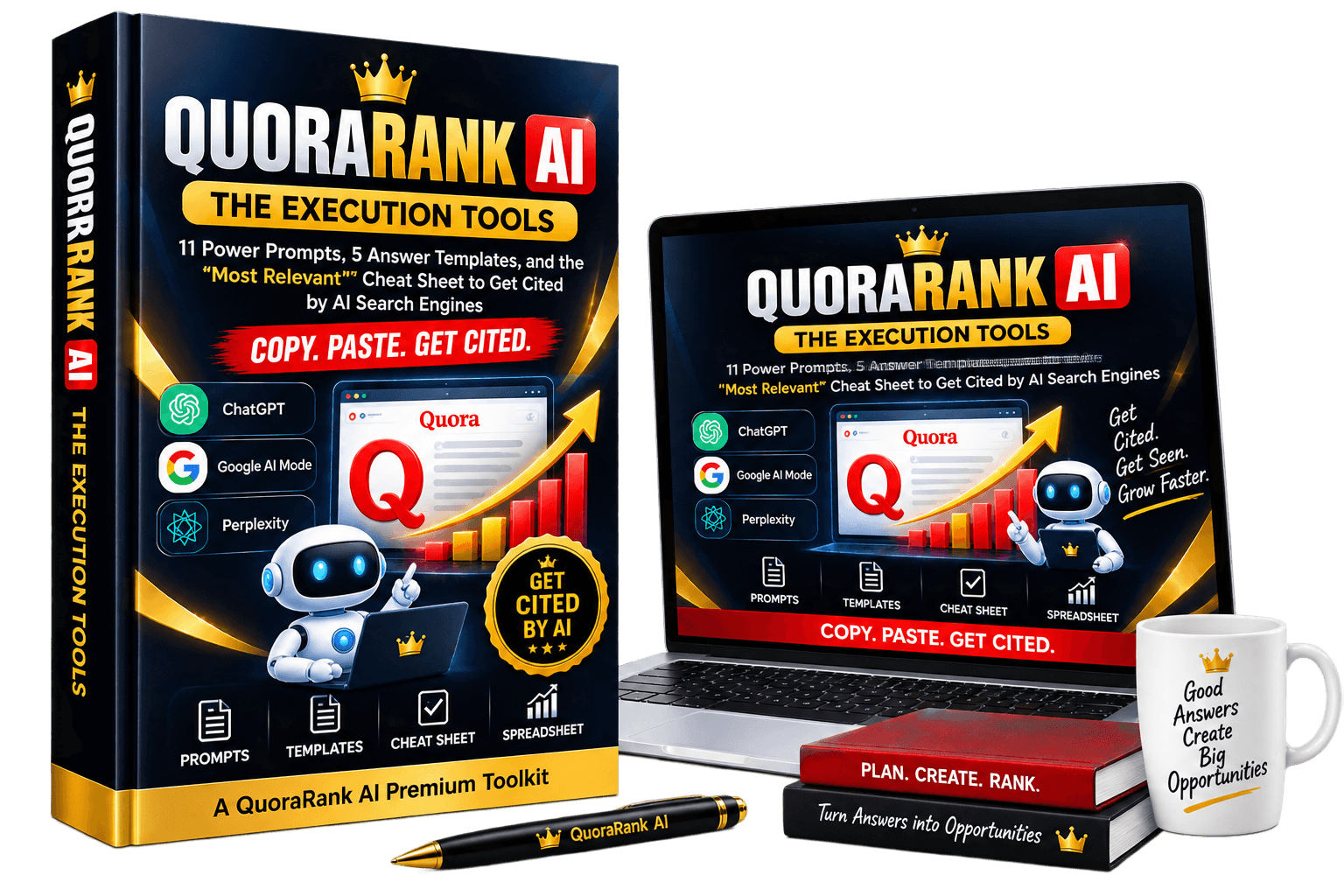
Copy. Paste. Get cited.
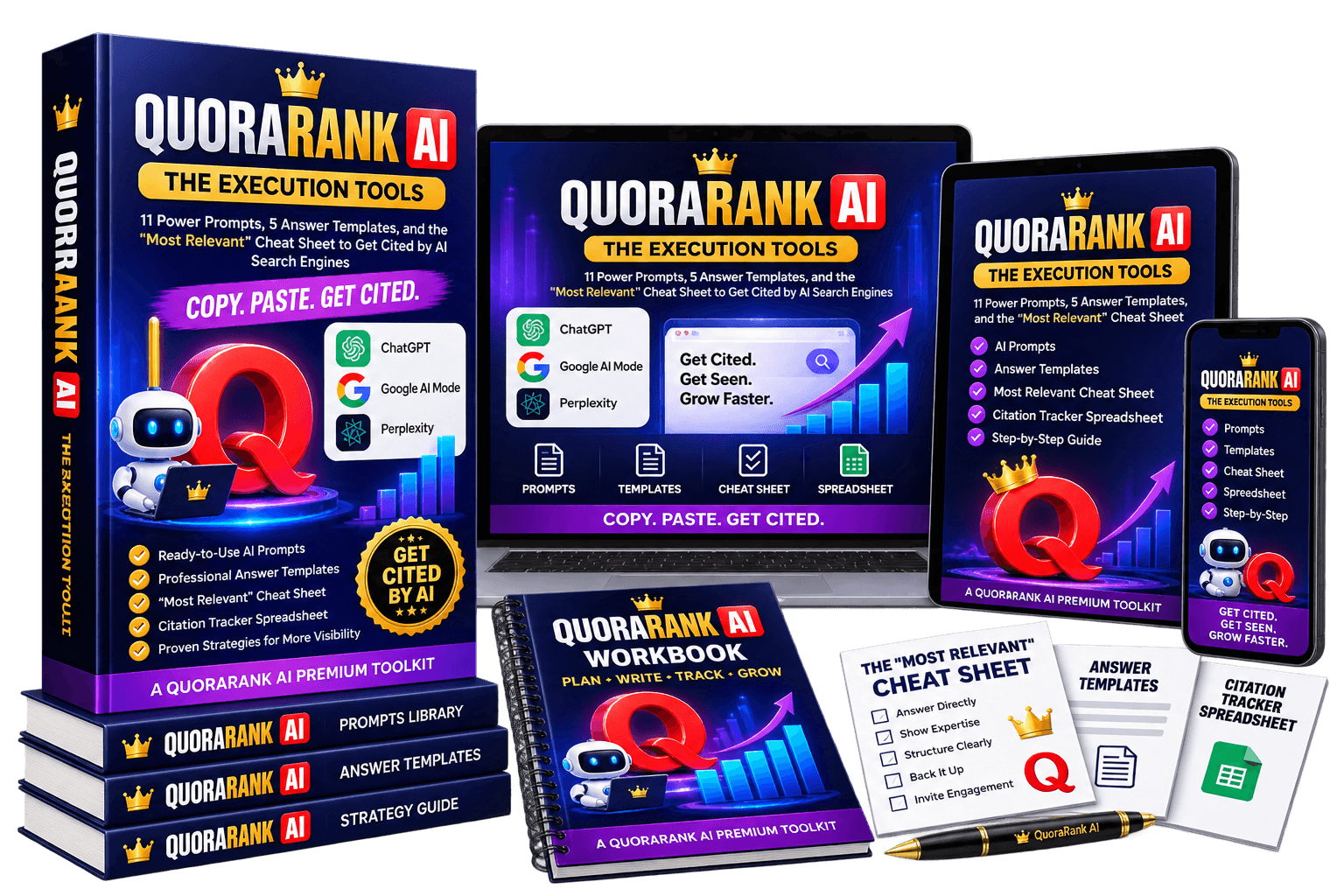
11 power prompts, 5 fill-in-the-blank answer templates, and the "Most Relevant" cheat sheet — built to turn the QuoraRank AI strategy into your first published, citation-ready answer today, not next month.
Real expertise, sharpened — not manufactured.
Every prompt here is built to structure and sharpen knowledge you actually have, not invent knowledge you don't. Where a prompt asks for "your experience," it means yours — you plug in what's actually true.
That's not a compliance footnote. It's the strategy. Quora's ranking systems — and the AI engines that scrape it — are both getting better at spotting generic, interchangeable answers. Specific, real, first-person detail is what survives, and what earns the citation.
Sixteen sections. Every one of them built to be used today, not studied.
11 Power Prompts
Copy-paste ready for ChatGPT, Claude, or Gemini.
5 Answer Templates
Fill-in-the-blank structures for direct, data-driven, step-by-step, comparative, and roundup answers.
"Most Relevant" Cheat Sheet
The 5-step formula plus a pre-publish checklist.
Citation Tracker Guide
A simple spreadsheet structure to log and monitor every answer you post.
30-Minute Quickstart
A minute-by-minute checklist from profile setup to your first post.
Profile Optimizer Guide
Photo, bio, credentials, topics, and content rhythm, covered step by step.
AI Engine Decoder
How ChatGPT, Perplexity, and Google AI Mode each source and cite content differently.
3 Bonus Power-User Prompts
FAQ extractor, long-tail question generator, and a depth auditor.
Robotic Phrase Swap List
Trade generic AI-sounding lines for ones that read like a real person.
50-Question Niche Bank
Ten ready-made questions across seven common niches.
3 Illustrative Sample Answers
Fully filled-in templates showing structure — not answers to copy-paste.
10 Mistakes That Kill Citations
Each one paired with the specific fix.
90-Day Roadmap
What foundation, momentum, and compounding look like stage by stage.
Monetization Playbook
Turning citations and profile visits into real inquiries.
Benchmark Guide
Rough, honest ranges to sanity-check your own pace.
Swipe File, FAQ & Glossary
15 opener lines, common questions answered, and every term defined.
3 of the 11 prompts, so you know exactly what you're getting.
Each one is written to be dropped straight into ChatGPT, Claude, or Gemini — you fill in the brackets with what's actually true for you.
The "Question Discovery" Prompt
Finds high-value Quora questions with strong citation potential in your niche, scored and ranked.
- Generates 20 real, well-formed questions in your niche
- Scores each one's citation potential, 1–10
- Ranks the top 5 and explains why
The "Answer Architect" Prompt
Builds a structured first draft around your real perspective — never invents details you haven't given it.
- Opens with a direct answer in the first 2 sentences
- Weaves in only the experience you actually provide
- Formats for 500–700 words with clear structure
The "Most Relevant" Optimizer
Optimizes an existing answer specifically to earn Quora's "Most Relevant" badge.
- Strengthens the opening 1–3 sentences
- Flags where a credible external source would help
- Follows Quora's own stated quality criteria
5 answer templates. Pick the skeleton, supply the substance.
Direct Expert
For direct, personal expertise on the topic.
Data-Driven
For research, statistics, or hard numbers.
Step-by-Step
For teaching a process from start to finish.
Comparative
For weighing two or more real options.
Expert Roundup
For synthesizing outside perspectives — real ones, properly attributed.
Not all AI engines cite content the same way.
Knowing the difference changes where you focus your energy — this is a condensed look at what's covered in full inside the toolkit.
ChatGPT
Leans on pages with a clear, self-contained answer near the top, and tends to favor recently active threads.
Perplexity
Shows its sources explicitly, so it favors content it can attribute cleanly, and rewards specific numbers and named tools.
Google AI Mode
Inherits traditional SEO signal and favors structured content it can lift cleanly into a summary box.
10 mistakes that kill citations — 5 of them, previewed.
Each one paired with the specific fix, so you can catch it before you post instead of wondering why an answer went nowhere.
| Mistake | Why it hurts | The fix |
|---|---|---|
| Burying the answer in paragraph 3 | AI engines often stop reading after the opening lines. | Answer directly in sentence 1–2. |
| Writing in vague generalities | Nothing specific enough to quote or cite. | Add real numbers, names, timeframes. |
| Wall-of-text formatting | Hard for both readers and crawlers to parse. | Use headers, bullets, short paragraphs. |
| Fabricated statistics or quotes | Erodes trust once someone checks; some engines cross-check claims. | Cite only what you can verify. |
| Ignoring comments and follow-up questions | Signals a low-effort, one-and-done post. | Reply within the first 48 hours when possible. |
The remaining 5 mistakes, plus the full fix for each, are inside the toolkit's Section 10.
One of three fully-written sample answers inside.
"What's the fastest way to get your first 10 customers?"
The fastest path is almost never advertising — it's going directly to people who already have the problem and are already gathered somewhere.
A few things that actually moved the needle in this example:
- Going where the problem is already being discussed, not where you wish your audience was
- Offering something concrete and low-friction instead of a generic pitch
- Following up personally for the first 10–20 conversations
This example is illustrative — a stand-in for the kind of specific, real detail you'd swap in from your own background. It isn't meant to be copied as-is, and it isn't a promise of what will happen if you post something similar.
From citation to client: the monetization playbook.
Getting cited is a means, not the end goal. Here's the 5-step path the toolkit walks through for turning visibility into actual inquiries.
Make your profile the landing page
Assume most traffic touches your profile first. Your bio should say exactly who you help and how, with one clear link — not five.
Answer where your buyers actually ask
Prioritize questions your ideal client would search or ask, not just the ones that are easiest to answer well.
Use a soft, earned mention — not a pitch
Reference your own work only where genuinely relevant, once you've already delivered real value in the answer.
Build a simple capture path
A free resource, short checklist, or newsletter signup linked from your profile turns an anonymous reader into a lead you can follow up with.
Track what converts, not just what's cited
A citation with zero profile clicks is a vanity metric. The Citation Tracker includes a column for inquiries, not just visibility.
This toolkit assumes you're already running the QuoraRank AI system.
Best fit
You've read (or are working through) the main QuoraRank AI guide, understand the FIND-CREATE-AMPLIFY framework, and want copy-paste execution tools instead of building your own prompts from scratch.
Not a fit
If you haven't started using AI tools to draft Quora content at all, or you're looking for a tool that posts or automates answers for you, this isn't that — every prompt here still requires your real input and judgment.
Don't have the main guide yet? This toolkit is built as a companion to it — you'll get the most out of these prompts alongside the core strategy.
A few things we want to be upfront about.
No guaranteed outcome
This toolkit does not guarantee that any specific answer will be cited by ChatGPT, Google AI Mode, Perplexity, or any other AI system, or that you'll earn a "Most Relevant" badge, a specific number of upvotes, or any amount of traffic, leads, or income. The benchmarks, roadmap, and sample answers inside are illustrative references, not commitments, and individual results depend on your niche, effort, existing platform algorithms, and factors outside anyone's control.
Not affiliated with the platforms named
This product is independently created and is not affiliated with, endorsed by, or sponsored by Quora, Inc., OpenAI, Google LLC, or Perplexity AI, Inc. ChatGPT and OpenAI are trademarks of OpenAI. Google and Google AI Mode are trademarks of Google LLC. Perplexity is a trademark of Perplexity AI, Inc. Quora is a trademark of Quora, Inc. All product and company names are used for identification purposes only.
No testimonials used
We haven't included customer testimonials on this page. The sample answers shown are labeled illustrative examples, not verified results from a real customer or campaign.
Everything above, delivered as one PDF, the moment you buy.
QuoraRank AI Toolkit — The Execution Tools
Instant PDF download. Read on any device.
- ✓ 11 copy-paste power prompts (ChatGPT, Claude, Gemini)
- ✓ 5 fill-in-the-blank answer templates
- ✓ "Most Relevant" cheat sheet + pre-publish checklist
- ✓ Citation Tracker guide, profile optimizer & AI engine decoder
- ✓ 50-question niche bank, swipe file, 90-day roadmap & more
One-time payment. No subscription. Prices and included bonuses may change without notice.
Get Instant Access — $27REFUND
This is a digital product delivered instantly on purchase. All sales are final — please review everything included above before buying.
Frequently asked questions
Do I need the main QuoraRank AI guide first?
It isn't required to use the prompts, but the toolkit is built as a companion to the main guide's FIND-CREATE-AMPLIFY framework — you'll get more out of it if you're already familiar with that system.
Can I reuse the same template for every question?
You can reuse a template's skeleton, but the content inside it should change based on the specific question — a Step-by-Step template forced onto a comparison question tends to read awkwardly and less usefully.
What if I don't have real data or statistics to cite?
Use your own direct experience and observation instead of inventing numbers. A specific, honest anecdote is more citable than a fabricated statistic — and far less risky, since some AI systems and platforms cross-check claims.
How do I know if I've actually been cited?
Periodically ask ChatGPT, Perplexity, or Google AI Mode a version of the question you answered, and check whether your answer, profile, or wording shows up in the response or listed sources.
Is any specific result guaranteed?
No. No specific outcome — including citation, upvotes, or income — is guaranteed. The toolkit gives you structure and prompts; results depend on your effort, niche, and consistency.
Open Quora. Find a question. Use the prompts. Post your answer.
Everything you need to execute is in one PDF, ready in the next two minutes.